Agents and the shape of work
We have some work to do together as a tech industry. Agents are inevitable, and we need to design the relationship we want to have with them.
Many early adopters of agents, including myself, have started to feel the urge to have many agents running in parallel and to always keep them occupied.
This is not a new desire at work — we all organize our work to happen efficiently. But now, the number of work items that can be happening in parallel is becoming practically unbounded.
On top of this comes an added burden of context-switching. Today, the experience involves agents coming back to you with results across many different applications — Claude, Cursor, Codex, and ChatGPT. Of course, you still have Slack, e-mail, and texts to attend to.
We are, of course, in the early days and on the leading edge, and right now the edge is sharp. But seeing where we're going should lead us to think about how we want things to be, so we can stop messy ways of working from lingering.
The risk is that we move fast on tasks at the cost of our judgement and perspective. That we become efficient but not effective, and robbed of our clarity and calm.
If we think about our future through the lenses of user experience and human-computer interface design, we are hopefully compelled to think beyond another conversational interface.
Instead, we would consider:
- cognitive aspects, like context switching
- psychological aspects, like need for achievement
- convenience aspects, like using a tablet with voice
Courtesy of Claude, here's a sketch of what such a workplace should look like:
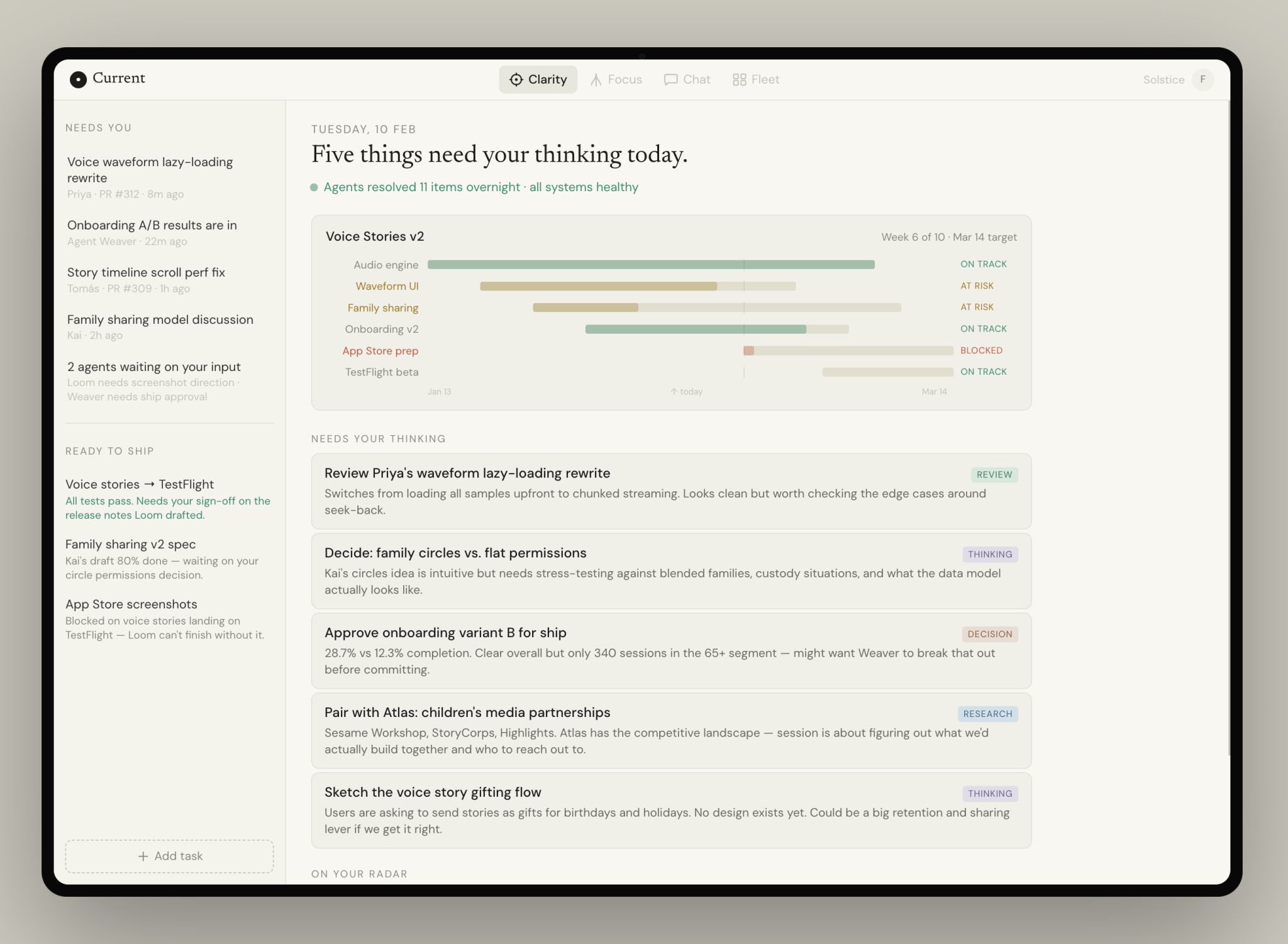
- one tab to gain clarity — progress, plans, problems
- one tab for focused work — review, research, read
- one tab for conversation — with agents and humans
- one tab for fleet — to see how agents are progressing
This is a simplification of a complex problem. But it illustrates what I hope is the future — a workplace designed to be productive and enjoyable, designed from first principles.
Whether it will be a product like Slack or something that many companies evolve internally, the best productivity tool of the next decade is going to be the one that best preserves our energy and clarity.